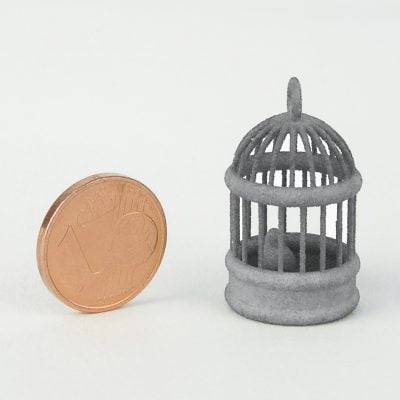
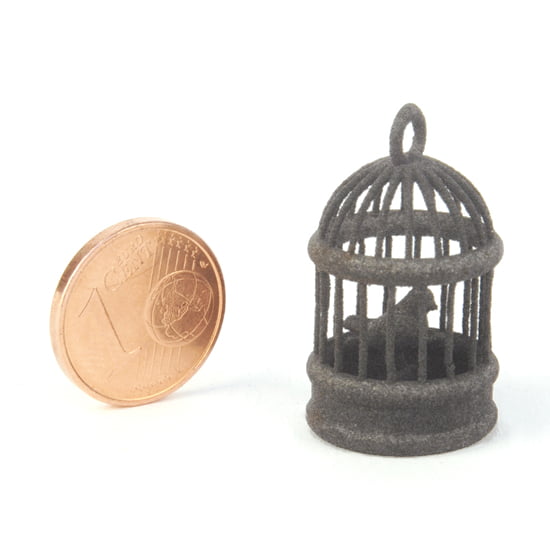
Material details
Titanium 6Al-4V (Grade 5) for the 3D metal printing with DMLS technology
I wait: • • •
Details: • • •
Resistence: • • • • •
Flexibility: •
– Lightweight and highly resistant
– Biocompatible
– Resistant to corrosion and high temperatures
Description
Titanium 6Al-4V (Ti6Al4V, Grade 5) is the most widely used titanium alloy in 3D metal printing. It is composed of titanium (88-90%), aluminum (5.5-6.5%) and vanadium (3.5-4.5%). It is printed with technology DMLS (Direct Metal Laser Sintering) on EOS industrial machines, with an accuracy of 30-40 µm per layer.
Titanium-based alloys are extremely hard and highly resistant to oxidation, acids and corrosion. The melting point is very high (1,660°C). Titanium Ti6Al4V has a very low toxicity and is biocompatible, making it suitable for medical applications such as implants, prosthetics, and customized surgical devices.
Material characteristics
With a density of 4.41 g/cm³, Titanium is significantly lighter than steel while offering excellent mechanical strength. Its strength-to-weight ratio is among the highest of all 3D printing metals, making it ideal for lightweight structural components in the aerospace, automotive, and industrial sectors.
The printed parts have a matte and slightly rough surface. Compared with the other materials for metal 3D printing, titanium has a medium surface roughness.
As for the’aluminum, metal 3D printing requires support structures to anchor the part to the platform and dissipate thermal stress. These structures are mechanically removed after printing.
Finishing and post-processing
Raw (crude) – The piece is sandblasted to remove residual dust and supports. The surface is matte and slightly rough. This is the standard option.
Polishing and grinding – the surface can be mechanically polished, ground or smoothed to achieve a smooth, shiny finish.
Mechanical machining (CNC) – for surfaces with precise tolerances, threads or mechanical fits, 3D printing can be integrated with turning, milling, drilling and tapping.
Heat treatment – Titanium parts are subjected to stress relief under vacuum after printing. Further heat treatments (HIP, aging) can optimize mechanical properties.
For custom finishes, specific surface treatments or particular certifications, contact us for a dedicated consultation.
When to choose titanium 3D printing
Additive manufacturing in titanium requires a high level of technical expertise and significant production costs. It's the optimal choice when the project requires complex geometries impossible to achieve with traditional machining, when the weight of a structural component needs to be reduced, or when specific properties such as biocompatibility or corrosion resistance in extreme environments are required.
Typical application sectors: aerospace (brackets, supports, ducts), medical (custom implants, prostheses, surgical instruments), automotive (high-performance components), industrial (valves, pumps, heat exchangers).
For simpler geometries, traditional machining of titanium can be more economical.
Maximum printable volume: 250 × 250 × 325 mm
You can not insert multiple objects into a single template / file.
Main features
- Moving and articulated parts: No (DMLS process does not allow moving parts)
- Support structures: Yes, requested and removed after printing
- Watertight: Yes (fully melted material, density ≥ 99.5%)
- Biocompatible: Yes
- For food: No
- Recyclable: Yes
- Layer thickness: 0.03–0.04 mm (30–40 µm)
- Density: 4.41 g/cm³
To find out all the rules to follow to create a model with this material, consult the sheet Technical details.
For a complete guide to file preparation, read our 3D printing guide.
Modeling Guides
To prepare a 3D model suitable for titanium printing, you can follow our guides:
- Autodesk Fusion – ideal for mechanical design and generative design
- Rhinoceros – for industrial design, jewelry and architecture
- Blender – for organic forms and digital sculpture
If your model was generated with AI, check out our guide on How to 3D print AI-generated models.
Dettagli tecnici
DIMENSIONS
Maximum printable volume: 250 × 250 × 325 mm
(EOS M280 / M290 cameras)
WALL THICKNESS
Minimum wall thickness: 0.5 mm
Minimum recommended thickness for structural strength: 1 mm
Unsupported walls (connected on one side only): minimum 1.2 mm
CLEARANCE AND DISTANCES
Minimum distance between surfaces: 0.5 mm
Dust escape hole: minimum 4 mm
Minimum hole diameter: 1 mm
DETAILS AND TEXT
Minimum size for object details: 0.5 mm
Embossed text: minimum 1 mm thick
Engraved text: minimum 1 mm deep; width must be at least equal to depth to allow for removal of residual dust
MECHANICAL PROPERTIES (indicative values – Ti6Al4V DMLS, as-built with stress relieving)
Tensile strength (UTS): 1,050–1,100 MPa
Yield strength (Rp 0.2): 950–1,000 MPa
Elongation at break: 8–14%
Elastic modulus: ~110 GPa
Hardness: 320–380 HV
Density: 4.41 g/cm³
THERMAL PROPERTIES
Melting point: 1,660°C
Thermal conductivity: 6.7 W/(m K)
Coefficient of thermal expansion: 8.6 × 10⁻⁶ /°C
CHEMICAL RESISTANCE
Excellent corrosion resistance, including seawater, chlorine, and organic acids. Highly resistant to oxidation.
BIOCOMPATIBILITY
Ti6Al4V is biocompatible and widely used for medical implants. Its specific properties depend on the surface finish and any post-printing treatment.
NOTES ON THE PROCESS
Technology: DMLS (Direct Metal Laser Sintering) on EOS M280 / M290 machines
Layer thickness: 30–40 µm
Support structures: required, mechanically removed after printing
Post-press treatment: vacuum stress relieving (standard)
Surface roughness (Ra, after sandblasting): 150–350 µm
Post-processing available: polishing, grinding, CNC machining, heat treatment (HIP, aging)
Mechanical values may vary depending on the print orientation and any subsequent heat treatments.
To receive the complete technical data sheet of the material, contact us.
For 3D file preparation requirements, please see our 3D printing guide.