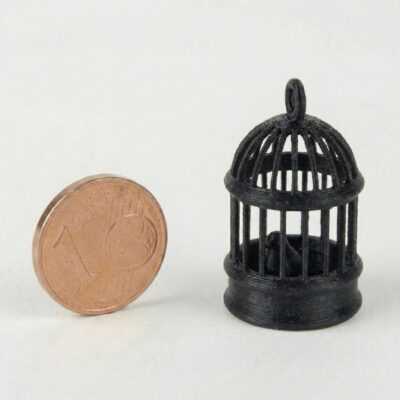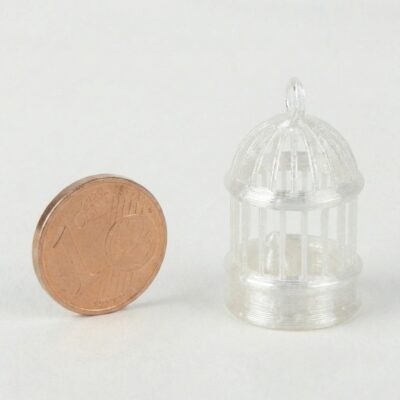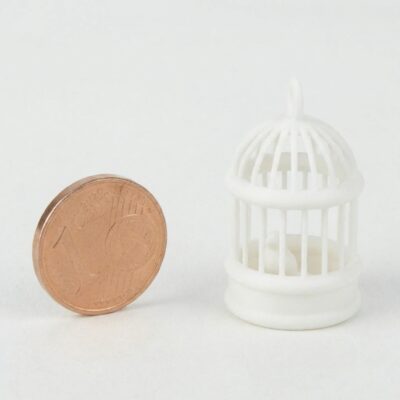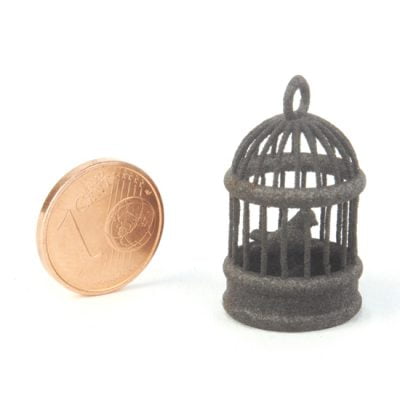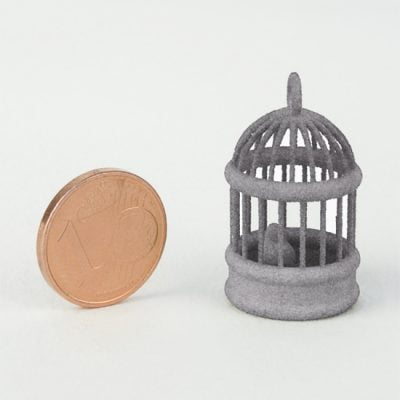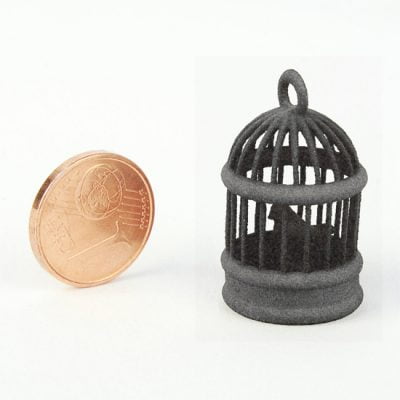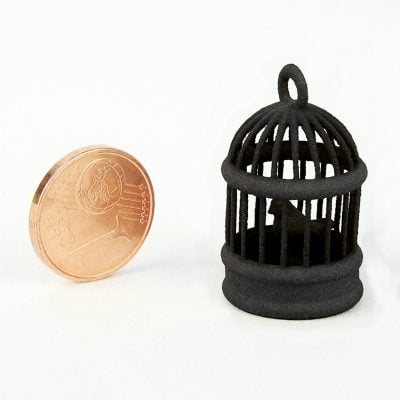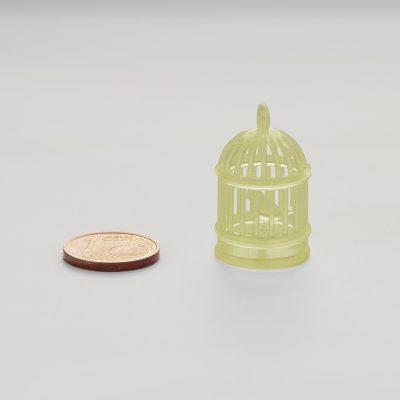
Material details
White plastic (Nylon PA12) for the SLS 3D printing
I wait: • • • •
Details: • • • •
Resistence: • • • • •
Flexibility: • • •
– Economical and versatile
– Strong and durable
– Flexible in low thicknesses
Description
The white plastic is a laser sintered polyamide 12 (Nylon PA12) with technology SLS (Selective Laser Sintering). It is the most versatile and widespread material in the 3D printing professional: it offers an excellent balance between cost, mechanical strength and design freedom, and is suitable for both rapid prototyping and the production of functional parts.
Objects are created layer by layer by a laser beam that selectively solidifies a PA12 nylon powder, with a precision of 100 µm (0.1 mm) per layer. Since the unsintered powder acts as a support during printing, it is possible to create complex geometries without support structures, including closed volumes, articulated chains and interconnected mechanisms.
Mechanical behavior
The properties of 3D printed nylon PA12 vary as a function of wall thickness. With a minimum wall thickness of 0.8 mm, the parts are flexible and can be bent. Above the 2 mm As the thickness increases, the elements become rigid and structural. This dual nature makes the material ideal for creating objects with a wide range of uses: from aesthetic and dimensional prototypes to functional mechanical parts such as covers for electronic devices, boxes, containers, hinges, and jewelry.
Thanks to the low concentration of amides, nylon PA12 has a low moisture absorption and good chemical resistance to oils, greases, and many solvents. The material is also biocompatible and dishwasher safe.
Available finishes
White PA12 nylon offers the widest choice of post-processing options of all 3D printing materials:
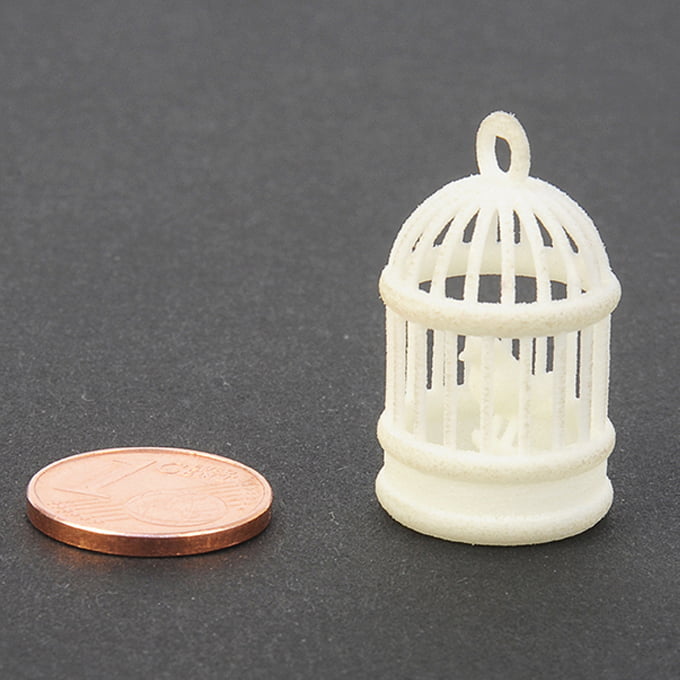
Raw (crude) – The part is sandblasted to remove residual dust. The surface is white, slightly grainy, and porous. This is the most economical option, ideal for prototypes and dimensional testing.
Mechanical polishing – the surface is smoothed by vibratory finishing, resulting in a smoother touch. For an even smoother result, the smooth plastic.
Dyeing – Objects are immersed in a dye bath that penetrates the material through a chemical reaction. The color is uniform, reaches even the internal surfaces, and is scratch-resistant. Available in various colors, including those from our range. colored plastic.
Painting – Spray finish with two-component acrylic polyurethane paint, available in any RAL color. Recommended for aesthetic prototypes and display pieces.
Chemical Smoothing – chemical-physical treatment that closes the surface porosity and gives a shiny appearance similar to injection molding. It makes the piece waterproof.
For special finishes, custom painting or specific needs (for example food grade or particular certifications), contact us for a dedicated consultation.
Maximum volume and cost optimization
Maximum printable volume: 677 × 368 × 565 mm
Production costs can be optimized by keeping the model within a volume of 180 × 230 × 300 mm. Larger objects are printed on large-format machines with higher unit costs.
You can not insert multiple objects into a single template / file.
Main features
- Moving and articulated parts: Yes (minimum clearance between parts: 0.5 mm)
- Watertight: No (yes with Chemical Smoothing finish)
- For food: No (available on request with food grade material – contact us)
- Suitable for dishwashers: Yes
- Recyclable: No
- Heat resistant: up to 80°C for continuous use; parts begin to warp above 150°C
- Layer thickness: 0.1 mm (100 µm)
- Biocompatible: Yes
To find out all the rules to follow to create a model with this material, consult the sheet Technical details. For a complete guide to preparing your file, read our 3D printing guide.
Modeling Guides
We have prepared step-by-step guides for the most popular 3D modeling software:
- Blender – for digital sculpture and organic forms
- Autodesk Fusion – for mechanical design and parametric CAD
- Rhinoceros – for design, jewelry and architecture
- SketchUp – for architectural modeling and interior design
- TinkerCAD – for beginners and educational projects
Dettagli tecnici
DIMENSIONS
Maximum printable volume: 677 × 368 × 565 mm
Optimal volume (low cost): 180 × 230 × 300 mm
Minimum object size: 7.5mm (X+Y+Z)
WALL THICKNESS
Minimum wall thickness: 0.8 mm (flexible)
Recommended thickness for stiffness: ≥ 2 mm
Maximum recommended thickness: 9 mm (beyond this value, deformations or surface defects may occur – in this case it is advisable to empty the model)
CLEARANCE AND MOVING PARTS
Minimum distance between moving parts (clearance): 0.5 mm
For large objects, clearance must be greater, as the heat of the SLS process can weld parts that are too close together.
Unsintered material exit hole: minimum 4 mm
DETAILS AND TEXT
Minimum size for object details: 0.2 mm
Embossed text: minimum 0.5 mm thick and 0.5 mm high
Engraved text: minimum 0.5 mm depth; the width of the engraving must be at least equal to the depth to allow for proper removal of residual dust
Note: Very thin cuts (0.3–0.6 mm wide) may retain sandblasting residue.
MECHANICAL PROPERTIES (indicative values – EOS PA 2200)
Tensile strength: 48 MPa
Tensile modulus: 1,700 MPa
Flexural strength: 58 MPa
Flexural modulus: 1,500 MPa
Elongation at break: 18%
Impact resistance (Charpy): 53 kJ/m²
Density: 0.93 g/cm³
THERMAL PROPERTIES
Melting point: 172–180°C
Heat Deflection Temperature (HDT, 0.45 MPa): 163°C
Heat resistance for continuous use: up to 80°C
To know in detail all the mechanical and thermal properties of the material, download the technical sheet.
For 3D file preparation requirements and common errors, see our 3D printing guide.